Wildlife
How to Identify Common Moorland Birds by Sight and Sound: A Beginner's Guide
A moor can look like nothing much: grass, heather, wind, and a lot of distance. Then the sound starts. A bubbling cry that seems to come from nowhere, a bird tumbling over the peat, a thin song pouring down from a speck high in the grey. Learning a handful of voices will do more for your moorland birding than any piece of kit, and you can do most of it before you ever lift binoculars.
What follows is a beginner's route in: which species to learn first, how they look, and — more importantly — how they sound.
Listen First, Look Second
Most beginners try to identify birds by looking. On open moorland that is the wrong way round. The birds are scattered, often distant, and coloured to disappear against the vegetation. Your ears work at ranges your eyes cannot match, and sound is the quickest way to know which species are actually around you.
Start with five: curlew, lapwing, skylark, meadow pipit and red grouse. Those five will cover the great majority of what you meet on a British upland walk in spring. Add golden plover, snipe, wheatear and stonechat as you go.
Timing matters more than gear. The best weeks are April to June, and the best hours are the first two or three after dawn. Wind is the enemy of listening: on a blustery day birds hunker down and calls get shredded. A still morning after overnight rain is close to perfect. If you can, walk into the wind — birds ahead of you will not hear you coming and are less likely to flush early. Keep your silhouette low and stop often.
The Curlew: The Moor's Signature Call
Big, brown, and unmistakable once you know it. The curlew has a long, down-curved bill — on females noticeably longer than the head — mottled grey-brown plumage, and a hunched, upright stance. There is no bold pattern to latch onto until it flies, and then you get the giveaway: a bright white rump and lower back flashing between dark wings, with slow, stiff wingbeats. They often fly in loose lines across the skyline.
The contact call is the one that names the bird: a rising whistle that climbs, holds, and falls away — cur-lee. The song, given in a fluttering display flight, is a long, liquid, accelerating bubble of notes. It carries a long way and is one of the great sounds of the uplands. If you stray near chicks, expect a harsh, scolding kerr.
The Lapwing: Tumbling and Peewitting
Lapwings look black and white at distance, but in good light the back is a dark, oily green-bronze that shifts as the bird turns. Note the long, thin, wispy crest and the white underparts. In flight the wings are strikingly broad and rounded, giving it a floppy, almost moth-like action unlike any other moorland bird.
The call is exactly as the old name suggests — a drawn-out, nasal peewit, two notes, the second higher. Listen too for a wheezy, anxious ch-e-e-w when you are close to a nest. The display flight is a rollercoaster tumble, the bird twisting and dropping through the air while calling.
The Skylark: A Song From Nowhere
A small, streaky brown bird with a short crest it raises when alert, a heavier body and a thicker bill than a pipit. On the ground it is easy to miss entirely, which is rather the point.
The giveaway is duration. A skylark sings for minutes at a time, rising in a spiral and then hovering, a continuous torrent of trills and warbles with snatches of other birds' songs thrown in. If a small brown bird is climbing steadily upwards and the song simply will not stop, you have your answer. Its flight call is a liquid, two-syllable chirrup, often given by birds moving low over the grass.
Smaller Voices: Pipits, Chats and Waders
Meadow pipit is the commonest upland songbird and the one beginners most often overlook. Streaky, slim-billed, with pale legs and a habit of pumping its tail. Its display flight is a rise followed by a parachute descent on raised wings, accompanied by a weak, high sip-sip-sip.
Wheatear shows a bold white rump and a black band across the tail as it flies, and hops upright on bare rock and short turf. Its call is a hard, dry chack.
Stonechat sits on the tops of gorse and bracken, flicking its wings. The call is a sharp chack-chack, like two pebbles knocked together.
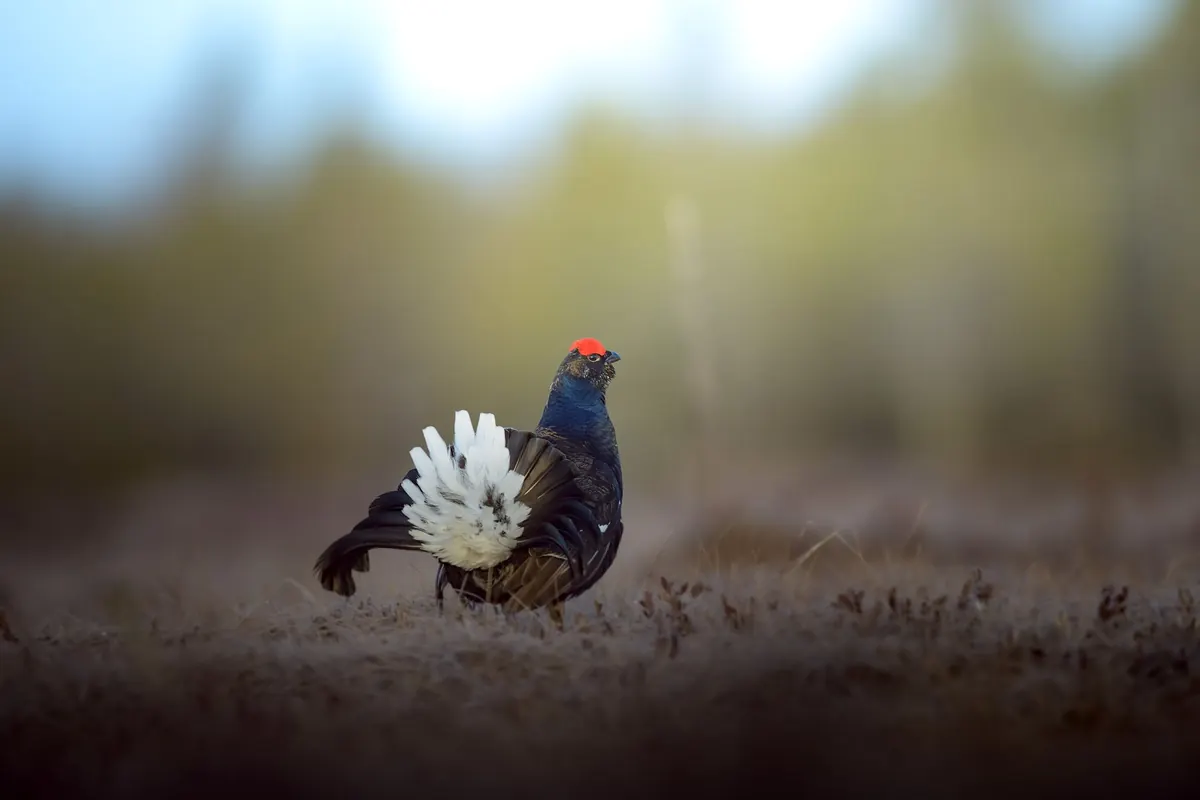
Red grouse is usually heard before seen: a repeated go back, go back, go back, then an explosion of wings from the heather at your feet and a low chuckle as it flies.
Snipe gives a sharp chipper chipper from cover, and in display flight produces a trembling, bleating hum — the drumming — as air passes over its stiff outer tail feathers during a dive. Golden plover gives a single, plaintive, far-carrying whistle that always sounds farther away than it is. Oystercatcher, absurdly, turns up along upland streams with a loud piping kleep-kleep.
Sorting the Confusions
Two pairs trip up beginners most often.
- Curlew or whimbrel? The whimbrel's bill is shorter, its head carries bold dark stripes, and its call is a rapid rippling titter rather than the long bubbling rise. It is mostly a passage visitor.
- Skylark or meadow pipit? Song height and length. Skylark: high, long, unbroken. Meadow pipit: short, weak, delivered on the way down.
- Wheatear or stonechat? Habitat. Wheatear on bare rock, stone walls and short grazed turf; stonechat on the top of scrub.
A Simple Routine for Your First Hour
- Stand still for five minutes before walking anywhere. Let the moor settle.
- Note every sound and write it down, even badly — "bubbling", "two notes", "wheezy". Descriptions beat guesses.
- Find the bird with your eyes only after you have a direction. Then raise binoculars slowly.
- Repeat the same walk in the same season. Familiarity with one patch beats racing around ten.
One last thing worth saying plainly: moorland birds nest on the ground, and many of them are legally protected from disturbance at the nest. Keep your distance, keep dogs close and under control, and stay on paths through the breeding season. Watching a bird behave naturally is worth far more than the few extra metres you might gain by pushing closer.
Photo: Nibman / Pexels
Related Articles